Tuesday, April 14, 2009

Slouching Toward Compassion and a Tea Party


I just finished reading Slouching Toward Gomorrah and The Tragedy of American Compassion. I have also been thinking a lot about a Tea Party on April 15th, hence the title. Both of these books and what I have seen and read about Tea Parties indicate an American human condition that extends past partisan politics and current events. I now understand no immediate fixes of an election or SCOTUS change are going to make everything all better. There needs to be a pendulum swing back to core principles that do not have an expiration date.


Robert Bork wrote about radical individualism and radical egalitarianism he especially saw while teaching at Yale. The individualism he is talking about is no civil rules, accountability, or personal responsibility for actions by an individual. The attitude that if it feels good then do it. The radical egalitarianism he is talking about is how no one should achieve more, accomplish more, or obtain more wealth than another person. Those who do have more are required to give this up to those who have less so that social justice will be met.


Marvin Olansky wrote about the changes in caring for the needy from the time the Mayflower landed at Plymouth Rock to the present day. The major difference between then and now is the dominant view of human nature. Cotton Mather warned his church members in 1698: "Instead of exhorting you to augment your charity, I will rather utter an exhortation... that you may not abuse your charity by misapplying it." His view, held for most of the 18th and 19th century by many, was that many persons, given a choice between working and not working, would choose to sit. He and others viewed the poor not as standing on the bottom rung of the social ladder, with the only choices stagnation or upward movement, but as resting in the middle, capable of moving either upward to economic independence or downward to defeated and dependent state of mind. I sure wish that had remained the dominant view.


Marvin Olasky writes an excellent musical scale from A to G of seven seals of good philanthropic practice:

A=affiliation defined as family ties

B=bonding defined as a personal connection to a charity volunteer

C=categorization defined as seeing an applicant for charity as either

1. worthy of relief

2. needing work rather than relief

3. not entitled to relief

D=discernment defined as personally knowing the applicant enough to detect fraud

E=employment defined as a willingness to work for food and lodging

F=freedom defined as the opportunity to work and worship without governmental restriction. Freedom grasped when an individual takes responsibility with his opportunity.

G=God defined as a recognition that true philanthropy must take into account spiritual as well as physical needs.


In 1947, Horace Greeley, founder and editor of the New York Tribune, is one of the first to lead people in the wrong direction we find ourselves in. "The heart of man is not depraved, his passions do not prompt to wrong doing, and do not therefore by their action, produce evil. Social distinctions of master and servant, rich and poor, landlord and land-less are the cause of evil. The way to end evil is to redistribute wealth so that all receive an equal share; one way to begin will be to have government tax the better off and distribute food and funds to those less well off."


Edward Bellamy, author of Looking Backward, followed Greeley in 1888. In the novel Bellamy's protagonist, Julian West, goes to sleep in 1887 and wakes in the year 2000. West, impressed by the equal division of abundant wealth in what has become an American socialist paradise, asks, By what title does the individual claim his particular share? What is the basis of his allotment? The wise denizen of the future, Dr Lette, replies, His title is his humanity. The basis of his claim is the fact that he is a man.


The theologian and key figure in the early 1900's Social Gospel movement, Walter Rauschenbusch said straightforwardly, "God is against capitalism."


During the Progressive Movement era, journalistic powers, William Randolph Hearst and Scripps-McRae newspaper chains denounced crooked wealth and called for the government to provide guaranteed incomes.


Moving on to the Great Society era of LBJ, the National Council of Churches became one of the leading sellers of entitlement. Council reverends argued not only that all the poor had a right to a handouts, but that the better-off should be ashamed if they did not provide them. They argued that poverty was still with us because of the influence of unrestricted economic individualism. The council demanded that the federal government provide leadership in the creation of adequate mechanisms for income distribution and income maintenance in an affluent society. The NCC brushed off the biblical statement that the poor would always be with us, since it arose in the past when the primitive status of human technology and the scarcity of developed resources existed. Since then, however, technological breakthrough have allowed for adequate levels of living for all.


I especially appreciate this little nugget from Olasky:
It is the thought that counts. We are not supposed to think too long, however, since what could be called Nike philanthropy demands that we "Just Do It." Cotton Mather's exhortation "that you may not abuse your charity by misapplying it" has long been buried.


So I am going to go to Tea Party armed with a lot of powerful ideas from a couple of books I highly recommend. I know that T.E.A is an acronym for Taxed Enough Already, and I would like to add another acronym S.E.A. for Spent Enough Already. The long list of examples I've listed from the books I just read show an entitlement attitude has been cultivated for a long long time. This entitlement spending and mindset has hurt instead of helped the poor and needy. It will be better if the pendulum swings back so personal individual shame in moving downward to a defeated dependency is the mindset of the majority. It will be better if more folks see themselves in the middle rung of the social ladder with freedom of opportunity to move up to economic independence.

Monday, April 06, 2009

They Just Want Their Bank Back

The bizarro behavior that the current leaders of Congress and Pres. Obama are showing toward financial institutions is puzzling to some. There are rumors that some of these institutions have offered to repay some bailout money, and the offer is refused. So, what's up with that? Here is a thought...maybe they just want their bank back.


I used my handy dandy GOP.com search engine for House bank scandal rubbergate. I came up with three excellent articles. Two were published on March 30, 1992, and the third was published on April 18, 1995. Two of these sources, Time and Newsweek, are much better than anything they are publishing these days. I encourage you to read them to refresh your memory of the kind of history the teachers in school do not mention.


From BusinessWeek The Secrets of Rubbergate


House seargeant-at-arms Jack Russ assigned each new member of the House a non-interest-bearing accounts at the House Bank. A lot of these folks were scratching their head wondering why anyone would want to put money in a non-interest-bearing accounts at the House Bank. The answer was never written down, but Hill veterans knew the secret: The bank provided free overdraft protection worth up to $2,000 a year and, indirectly, interest-free loans up to a members' net monthly salary, or about $7,000. This more than compensated for the lack of interest on deposits.


Congress exempts itself from regulation and oversight.


The House Bank had some of the trappings of a commercial banking institution--accepting deposits, offering checking accounts, and, indirectly through the overdrafts, making loans. But Congress has long insulated itself from the laws it imposes on others, from civil rights to workplace safety, and the House Bank was similarly exempt from the state and federal regulations that govern more traditional banks. It did not have to pay attention to rules requiring charters, capital reserves, examinations, and fees for deposit insurance.


What's more, an analysis of some of the arcane procedures at the bank suggests that despite denials by lawmakers, taxpayers' money was used to support the bank's operations. Every year, taxpayers footed the bill for the salaries and other administrative costs of running the bank, to the tune of at least $1 million. Furthermore, taxpayers may have helped finance House members' overdrafts. These were so pervasive that the staff included one person whose sole job was to ask members to cover their bad checks. When members overdrew their accounts by more than their next month's net salary, as was often the case, "technically and legally, they were dipping into public money," says Representative Fred Grandy (R-Iowa), one of six House members who investigated the bank scandal.


HOW THE HOUSE BANK WORKED


1 House members' paychecks placed in an account at Treasury to which House Bank had access. Riggs Bank was a conduit for other House Bank deposits


2 Members wrote checks to third parties such as dry cleaners, which were processed by the Federal Reserve's national check-clearing system and returned to the House Bank


3 The House Bank wrote checks on the Treasury account in amounts equal to the third-party checks it was called upon to pay. Riggs processed members' other checks free of charge


4 Checks written on insufficient funds were not bounced. Treasury funds, as well as deposits of other members, may have been used to cover overdrafts


From the Newsweek article you find the following-


The muck slopped over onto the House post office, the scene of embezzling and alleged cocaine dealing by employees. With Minority Leader Robert Michel saying there was evidence of "money laundering" at the facility, postmaster Robert Rota resigned-the second House officer in a week to do so under a cloud.


The post office might have redeemed stamps for cash, in effect allowing legislators or their staffs to steal public money. With the U.S. attorney for Washington, D.C., on the case, Speaker Thomas S. Foley could well declare that "the era of patronage is over." Promising to put a professional financial officer in charge of House transactions, Foley said he would eliminate some perks and impose real-world fees on others, like the free pharmacy and the nearly gratis gym.


From the Time article we learn about Mrs. Rubbergate-


Mrs. Solarz admitted that she knew her husband's House account was overdrawn when she ordered a congressional staffer to write a check for $5,200 in 1990. She is not expected to serve jailtime. Ex-Rep. Solarz, who himself had a large number of overdrafts from the House Bank, was cleared by a task force. It was the eleventh criminal charge to emerge from the 1992 "Rubbergate" scandal.


All this talk recently about how those greedy people in financial institutions were not regulated enough by Congress has reminded me of this scandal. Some things simply do not pass the smell test. If Congress wants to work on more regulations, then I suggest they begin by just regulating themselves, Remove exemptions of privileges to them that all of the rest of us have to put up with. Just a thought.

Sunday, March 29, 2009

What's My Line?


Some may be old enough to remember this TV game show in the 1950's. The panel would be blindfolded as the mystery celebrity appeared on the show. Listening to him they would try to figure out who he was. Instead of listening you can read and try to figure out who this person is.


I was born on an island, and my parentage, as others have sneered was irregular. After my birth my ne'er-do-well father deserted me. In my early teens my mother was lost to me too. It was left up to others to give me an opportunity to receive a good education, and I was able to continue my studies on the mainland at a prominent university in the northeast.


There is no doubting that I was serious about college, and I was ambitious and impatient to make my way in the world. It is this manipulative ability, this capacity to use people as a means to what I conceive to be a higher end, that describes me best. This higher end or purpose of mine in the years from, say '77 to '01, was the construction of my own political utopia in America.


I searched for ways to remedy the defects of the union by strengthening the central government at the expense of the states.


To my acquaintances I proposed my own system of government which, while not ideal since the people, I believed, were agog with republicanism and incapable of political realism-came closest to the limited monarchy I secretly preferred. The chief executive and senators should hold office for life, subject only to good behavior. The president must have a veto over all Federal and state laws, he held, in order to balance a democratic lower house against the propertied interest of the senate. And, finally, governors of the states-mere administrative units in my conception-should be appointed by the president, whose only check would be from congress and a Federal judiciary empowered to declare laws unconstitutional.


Consider one of the republicans who came over to my position, I revolutionized his mind. I always pride myself on having my way with people. In boldly arguing this scheme of government I am likewise trying to manipulate other highly influential men, national opinion-makers, into a favorable attitude towards what I consider a more realistic plan of government which I know to be too advanced for them to accept.


I now am bending this nation more and more to my will by defeating the strong, resisting forces of localism and tradition.The empire of my vision is the modern, totalitarian state. I see the only hope for passion-driven man in the absolute security of the Leviathan state. There are no exemption from the imperfections, the weaknesses, and the evils incident to society in every shape. Not the protection of their natural rights to life, liberty, and property, but the lust for power, is the motive of men in political associations.


This pessimism about man left to himself, this fear of man's arbitrariness, is what motivates me to seek more and more centralization of government so as to save men from themselves. I am prepared to choose security as against liberty if the choice must be made. But in my mind, it is not really security but the "general good" that must be served. Interspersed among my writings is this phrase and many other terms like "the public safety," "the public interest," and even "the general will," all vaguely describing what I view as that transcending, ultimate end to which politics is only a means. The first thing in all great operations of such a government as ours is to secure the opinion of the people. Public opinion is "the governing principle of human affairs," and I have no doubt that it can be conditioned to accept the totalitarian state that alone could prevent the abuse of human liberty. How can I save other men from their own destructive, selfish passions except by rendering them impotent as moral agents before the ethical state.


They are vicious, their passions may be operated upon. Take mankind as they are, and what are they governed by? Their passions. There may be in every government a few choice spirits, who may act from more worthy motives. One great error is that we suppose mankind more honest than they are. Our prevailing passions are ambition and interest; and it will ever be the duty of a wise government to avail itself of the passions, in order to make them subservient to the public good, for these ever induce us to action.


My critics have no theory, no general principles. Can that man be a systematic or able statesman who has none? I believe not. No general principles will hardly work much better than erroneous ones. I, in my utopian scheme for a great Federal power, am prepared to use immoral means, and, I never subscribed to the Declaration of Independence with its doctrine of the natural rights of the person.


I never understood the Western concept of the individual and his inalienable rights. I justify coercion of the individual in order to achieve the perfect society of my dream. Freedom is a great treasure, but it must be organized against abuse. Unrestrained man's freedom degenerates into license and anarchy.


I do not realize that society, the state, or any organization exists for the good of the individual and not vice versa. I reject the principle that man must be free to use his faculties, to act on his own initiative, employing his own means towards the end that he has chosen, without the regimentation of the state. As a social engineer who finds man depraved and unpredictable, I'm committed to "liberating" man from himself by trying to force him into static political and financial classes and structures which can then be absorbed by the total state into a transcendent unanimity. I am not preoccupied with man, but his social relations. Factionalism must be prevented, even if it means the sacrifice of personal liberty. Ideological consensus would make factionalism unnecessary, since factionalism is a kind of alienation which must disappear once men come to realize where their real interest lay and praxis is at last achieved.


Government, the Declaration notwithstanding, is not based upon some fabled consent in the past, but upon accepted conventions. Its validity is not to be found in natural law and its self-evident truths of reason but in utility, There are, hence, no rationally discoverable absolute truths and values to limit the modern state in its self-aggrandizement.


The preamble of the Federal Constitution, lodging all power and initiative in We The People, is enough to mar the charter in my estimation; for how could the impure, the non-chosen organize a true common-wealth? My basic premise is that of all utopians, religious and secular: man's corrupted nature, issuing in license rather than freedom, must be restrained by government, which can only be organized by the chosen. Only in this way can man be made to overcome his selfishness and live in the ideal society where his own good is transcended by the public good. To this end, the realization of the secular, where public virtue will replace private greed, the Federal government must have much more power than the Constitution provides. This means attacking the principle of subsidiarity in the Constitution where the rights of persons and states are protected against the encroachment of the central government.


Republicans recognition, in varying degrees, is that justice, and ultimately charity, alone binds the good society together. My philosophy of man and society is mechanistic and cold, legalistic in the extreme.


My motivation for the nation's economy is not moral but political, reminiscent of the old mercantilists and appropriation of government for their own economic purposes. In principle, treating man as a means rather than an end; and while this politicized economy at first serves my centralistic purpose by wedding the money interest to the national state, it has led to cartels and other international combinations which dominate states rather than serve them. Corporate systems, with incomes greater than some modern states, are creating a new kind of internationalism. This is the paradox. Only the small entrepreneur and the small holder of property, marginal in my theory of the state, remain in the low condition to which I relegate them and continue to decrease in number as huge, international corporations multiply. Special interests, not the "common good," prevail and tyrannize over nations and their people.


I am Alexander Hamilton


I was in a philosophical kind of mood on this Sunday, and I used my hand dandy GOP.com search engine with the key words - Alexander Hamilton ruling class that brought me to this web article - Alexander Hamilton: From Caesar to Christ


To be fair to Alexander Hamilton, in the final tragic years of his life he became a Christian, and he sincerely repented of his past sins. An excerpt:


This dilemma of choosing between Caesar and Christ in the most personal, existential sense could be resolved in only one way. In his final letter to Eliza, written at 10:00 P.M. the eve of the fatal interview, Hamilton described what he would do:


The scruples of a Christian have determined me to expose my own life to any extent rather than subject myself to the guilt of taking the life of another. This much increases my hazards, and redoubles my pangs for you. But you had rather I should die innocent than live guilty. Heaven can preserve me, and I humbly hope will; but in the contrary event I charge you to remember that you are a Christian. God's will be done! The will of a merciful God must be good.


Then, in a tender gesture of love for his dead son, Philip, and all his children, Hamilton lay down next to twelve-year-old John and recited with him the Lord's prayer.


The next morning, July 11, 1804, Hamilton was mortally wounded by Aaron Burr as they faced each other, nationalist and disunionist', or the last time on the banks of the Hudson. The evil passions of man, which Hamilton had sought futilely to transcend mechanically in some visionary social and political system, were now overcome and transcended spiritually in Hamilton himself by an act of love for his fellow man in Christ. As he had said he would, in his letter to Eliza and in a memorandum discovered after his death, Hamilton had reserved and thrown away his first fire, even his second.


As he lay dying in the bosom of his loving family, one thing alone remained for Hamilton. He sent for Bishop Richard Moore, Episcopalian bishop of New York, and begged to be united to the church by receiving Holy Communion. "Do you sincerely repent of your sins past? Have you a lively faith in God's mercy through Christ, with a thankful remembrance of the death of Christ? And are you disposed to live in love and, charity with all men?" Yes, yes, yes. "I have no ill-will against Colonel Burr. I met him with a fixed resolution to do him no harm. I forgive all that happened."

Saturday, March 21, 2009

Boehner & Cantor Missed an Opportunity-Don't Hold a Grudge Against Them

The House passes punishing taxes on AIG and other bonuses as reported by a local TV station in Portland, OR. I got this link using my handy dandy GOP.com tool bar, by the way.


I think that Boehner and Cantor missed an opportunity the whip the entire Republican members of the House to vote "Present" on this bill. Here is why I wish they had chosen this strategy. This so-called "outrage" of the money, reported in the media over the weekend, to traders in the unit that nearly brought about the company's collapse was intended to be channeled by Obama and the Democrats in Congress away from them. They manufactured the circus atmosphere to channel the outrage toward the recipients of the bonuses so the outrage would not be directed toward them. Democrats were responsible for removing a provision, originally contained in stimulus legislation, to ban such bonuses. So, we should channel our outrage toward all but seven House Democrats, and all the Senate Democrats plus three Senate Republicans who voted Aye for this stimulus bill. We should channel our outrage toward Obama who signed this bill into law. This is one of the few times when the House Republicans could rightfully say that they were mere spectators to the "circus in town." None of the House Republicans had voted for a bill that allowed for the bonuses to be awarded. I also think it would have been easier to whip them to vote "Present" than it was to whip them to vote "Nay."


Now I expect that some are going to tell me how this tax bill is so wrong that the only acceptable vote is "Nay." I will not argue with you on the merits because I do not disagree with you. The point I am making is that this bill and the outrage was a sideshow circus, and it was going to pass in the House without the 85 House Republicans who voted "Aye." If you're creating a circus you may as well have some spectators. Politicians are sometimes weaklings, and some did not want to be put on the spot in their district of supporting bonuses to the traders who nearly brought about the collapse of AIG. They could have went back to their district and explained that they had no reason to participate in a circus that was not of their making. They had voted against the Stimulus bill, and they had no reason to paper over a mistake because they did not make it.


Finally, I ask that we not hold a grudge against all 85 House Republicans who voted "Aye." Yes, they were wrong on this vote, but most of the time they vote right and are working on our behalf instead of working against us. We need to increase our numbers instead of decrease our numbers by eating our own. I agree with writing and calling them for this wrong-headed vote. After you have made clear to them how you really feel about it please do not continue an ongoing grudge against them.

Thursday, March 19, 2009

Well, who were these Capitalists?

HUAC Hearings on Capitalist Infiltration of the Motion-Picture Industry, 2009-10


Testimony of Kelsey Grammer


MR. FRANK. Now, what is your present occupation?


MR. Grammer. Actor....


MR. FRANK. You understand that we desire to learn the true extent, past and present, of Capitalist infiltration into the theater field in Hollywood, and the committee asks your cooperation in developing such information. There has been considerable testimony taken before this committee regarding a number of organizations in Hollywood, such as the Actors' Laboratory; Actors' Laboratory Theater; Associated Film Audiences-Hollywood Branch; Citizens' Committee for Motion-Picture Strikers; Film Audiences for Democracy or Associated Film Audiences; Hollywood Anti-Nazi League or Hollywood League Against Nazism; Hollywood Independent Citizens' Committee of the Arts, Sciences, and Professions; Hollywood League for Democratic Action; Hollywood Motion-Picture Democratic Committee; Hollywood Peace Forum; Hollywood Theater Alliance; Hollywood Writers' Mobilization; Motion Picture Artists' Committee; People's Educational Center, Los Angeles; Mooney Defense Committee- Hollywood Unit; Progressive Citizens of America; Hollywood Committee of the Arts, Sciences, and Professions; Council of the PCA; Southern California Chapter of the PCA; Workers School of Los Angeles.


Have you been connected or affiliated in any way with any of those organizations?


MR. Grammer. I have....


MR. FRANK. Will you tell the committee whether or not in your experience in Hollywood and as a member of these organizations to which you have testified there were to your knowledge Capitalists in these various organizations which I have referred to, particularly those that you were a member of?


MR. Grammer. I think I can say "Yes" to that.


MR. FRANK. Well, who were these Capitalists?


MR. Grammer. There were people in the Actors' Lab, for instance--this, in my opinion, was not a Capitalist organization in any sense of the word. As in any organization, it has all colors of political philosophy....


MR. FRANK. Well, were there Capitalists attached to these other organizations which you say you were a member of?


MR. Grammer. This I'm not familiar with. I don't know. I don't know who else was a member of them besides myself.


MR. FRANK. Your answer is because you do not recall who were members of these other organizations?


MR. Grammer. I think that is the gist of my answer; yes.....


MR. FRANK. Well, what was your opportunity to know and to observe the fact that there were Capitalists in [the Actors' Laboratory]?


MR. Grammer. May I answer this fully and in my own way?


MR. FRANK. I would like for you to....


MR. Grammer. I am not a Capitalist. I would like to point out that in my opinion there is a great difference between--and not a subtle difference--between being a Capitalist, 10 years ago, and being a Capitalist now. To my mind this is a great difference and not a subtle one....


As I say, I am not a Capitalist. I was a member of the Capitalist Party when I was a much younger man, 10 years ago. I was a member of the Capitalist Party....


Being a member of the Capitalist Party fulfilled certain needs of a young man that was liberal in thought, idealistic, who was for the underprivileged, the underdog. I felt that it fulfilled these particular needs. I think that being a Capitalist in 2009 in this particular situation is an entirely different kettle of fish when this is a great power that is trying to take over the world. This is the difference....


MR. FRANK. In other words, you didn't realize that the purpose and object of the Capitalist Party was to take over segments of the world earlier, but you do realize that that is true in 2009? Is that the point you are making?


MR. Grammer. Well, I would like to say this: That this is in no way an apology for anything that I have done, you see, because I feel I have done nothing wrong ever. Question of judgment? This is debatable. I feel that as far as I am concerned that earlier, as far as I knew it, the purposes as I knew them fulfilled...certain idealism, certain being for the underdog, which I am today this very minute....


I wasn't particularly interested in it after I did become a member. I attended very few meetings, and I drifted away from it the same way that...I drifted into it....To the best of my recollection, I petered out later


REPRESENTATIVE LYNCH (HUAC Committee Member). Who would call these meetings together?....


MR. Grammer. I would prefer not to mention names under these circumstances....


REPRESENTATIVE Maloney (HUAC COMMITTEE chairman). Mr. Grammer, in what way do you feel it would be injurious, then, to them to divulge their identities, when you expressed the opinion that at no time did they do wrong?


MR. Grammer. This brings up many questions on a personal basis, Mr. Congressman, as an actor....One of the reasons is that as an actor my activity is dependent a great deal on the public. To be called before this committee at your request has a certain inference, a certain innuendo that you are not loyal to this country. This is not true. I am speaking for myself. This is not true. But the inference and the innuendo is there as far as the public is concerned....


MR. Maloney. Don't you feel the public is entitled to know about [Capitalist infiltration of the motion picture industry]?


MR. Grammer. I certainly do, and I am opening myself wide open to any question that you can ask me. I will answer as honestly as I know how. And at this particular time, as I say, the industry is--it's like taking a pot shot at a wounded animal, because the industry is not in as good a shape today as it has been, economically I'm speaking. It has been pretty tough on it. And, as I say, this is a great industry, and I don't say this only because it has been kind to me. It has a very important job to do to entertain people, in certain respects to call attention to certain evils, but mainly to entertain, and in this Ifeel that they have done a great job. Always when our country has needed help, the industry has been in the forefront of that help....


On the question of naming names, it is my honest opinion that the few people that I could name, these names would not be of service to the committee at all. I am sure that you know who they are. These people I feel honestly are like myself, and I feel I have done nothing wrong. Question of judgment? Yes, perhaps. And I also feel that this is not--to be asked to name names like this is not--in the way of American justice as we know it, that we as Americans have all been brought up, that it is a bad thing to force a man to do this. I have been brought up that way. I am sure all of you have.


And it seems to me that this is not the American way of doing things--to force a man who is under oath and who has opened himself as wide as possible to the committee--and it hasn't been easy to do this--to force a man to do this is not American justice....


My people have a long heritage in this country. They fought in the Revolutionary War to make this country, to create this Government, of which this committee is a part....


I don't think I would be here today if I weren't a star, because you know as well as I, even better, that I know nothing that I believe would be of great service to this country. I think my career has been ruined because of this, and I would appreciate not having to--don't present me with the choice of either being in contempt of this committee and going to jail or forcing me to really crawl through the mud to be an informer, for what purpose? I don’t think this is a choice at all. I don't think this is really sportsmanlike. I don't think this is American. I don't think this is American justice. I think to do something like this is more akin to what happened under Hitler.


I don't think this is American justice for an innocent mistake in judgement, if it was that, with the intention behind it only of making this country a better place in which to live. I think it is not befitting for this committee to force me to make this kind of choice....


The above is a hearing that has not yet taken place. I took the testimony from a real hearing that took place in 1951. I changed one word, Communist, and replaced it with the word Capitalist. I changed the actor from Larry Parks to Kelsey Grammer, and I changed the politicians from Tavenner, Potter, and Woods to Frank, Lynch, and Maloney. The hearing in House with the CEO of AIG struck me as a new 21st century version of McCarthyism, only this time the targets are capitalists

Obama - Our economy is very sick


Senate Majority Leaders Harry Reid says: "Coal makes us sick. Oil makes us sick."


House Speaker Nancy Pelosi recently told a group of both legal and illegal immigrants and their families that enforcement of existing immigration laws, as currently practiced, is "un-American."


If the President, Senate Majority Leader, and Speaker of the House want to see what is very sick, what is making us sick, and what is un-American, then all they need is a mirror.

Friday, March 13, 2009

I Am The Banking Queen


Sung to Dancing Queen by Abba


Banking Queen


Oooooooo

Oooooooooo


chorus


You can build.

You can buy.

Any house your heart desires.

Oo zero down.

Financing.

I am the banking queen.


first verse


Friday night and your cash is low.

I know a place that you can go.

Oh, get your house and use it.

Go ahead abuse it.

You can do anything.

Go out and have a fling.

I am the banking queen.

Old and sweet didn't do a thing.

Banking queen.

Don't complain or you'll hear me scream oh yeah.


repeat chorus

second verse


Told the bankers hey you guys.

Make the loans or it's your behind.

My friends at Fannie sure need it.

Do it my way or beat it

Why are the stocks crashing?

That doesn't mean a thing.

I'm still the banking queen.

Never spanked for a single thing.

Banking queen.

Don't complain or you'll hear me scream oh yeah.


repeat chorus fade out


Paul Shanklin wrote these lyrics as a parody song about Rep. Barney Frank, but an article by Michelle Malkin reveals how Barney is in for some strong competition from Rep. Maxine Waters. an excerpt from her article:


At a flail-and-wail House hearing last month, California Democratic Rep. Maxine Waters melted down in front of big banking CEOs. "Raise your hand! Raise your hand!" she shrieked as she harangued the executives on their business practices and management of federal bailout money. Sneering at the "captains of the universe," whom she refused to address by name ("You, Bank of America!"), Waters excoriated the corporate heads for their greed.


Fast-forward a month later. The Wall Street Journal reported Thursday that the high-and-mighty Waters had a personal and financial stake in Boston-based OneUnited, a minority bank that received $12 million in TARP money under smelly circumstances. The banks' executives donated $12,500 to her congressional campaigns. Her husband, Sidney Williams, was an investor in one of the banks that merged into OneUnited.


Waters (along with Frank) participated directly in pressuring the feds for OneUnited's piece of the bailout pie. She personally contacted the Treasury Department last December requesting $50 million for the company -- and failed to disclose her ties to the bank to them. The government ended up coughing up $12 million in TARP funding for OneUnited -- despite another government agency rapping the bank in October 2008 for "operating without effective underwriting standards and practices," "operating without an effective loan documentation program" and "engaging in speculative investment practices."


Oh, and get this: The favored bank of Maxine Waters was also penalized for alleged excessive executive compensation. The FDIC ordered the bank to "sell all bank-owned automobiles," require reimbursement for executives' car purchases (according to the Boston Business Journal, OneUnited CEO Kevin Cohee was cruising around in a 2008 Porsche SUV), and cease payments on a $6 million Santa Monica beachfront home purchased by Cohee, his wife, Teri Williams, who served as bank president, and others.


Responding to scrutiny of the bank's special treatment, Cohee is now accusing critics of -- yep, you guessed it -- racism.


Now, who is sick of Democratic shakedown artists sanctimoniously lecturing others about the culture of corruption? Raise your hand! Raise your hand!


I raise my hand, and I have a question for elected Republican and conservative members of Congress. When are you going to start attacking these vile people in the House the way it was done in the early 1990's? Are you so cowed and timid that you have to leave it up to Michelle Malkin, Mark Levin, or Rush Limbaugh to attack these folks? Come on, grow a spine and show some leadership. My grandchildrens' future depends on it.


She Turned Me Into a Newt?...a Newt?...I Got Better


Anyone familiar with Monty Python understands where I got the title for this diary. The photo is a disturbing reminder of a flirtatiion that Newt Gingrich had recently with the "issue" of global climate change. The quote of the week below is hopefully a sign that he has gotten better.


QUOTE OF THE WEEK


I've lived through '64, '74 and '92. In '64 we were beaten so badly people talked about whether the party had a future. By '66, Lyndon Johnson had gone so far to the left and split the Democratic Party and we gained 47 House seats and picked up a bunch of governorships and Senate seats. Since 1968 you have not elected an overt liberal in 40 years. In '74 to '76, we had Watergate and a bad recession and then a Reagan-Ford nomination fight. In that period, only 17 percent of the country identified itself as Republican and yet four years later, Reagan won a smashing victory and Carter collapsed under a bad economy. In '92, Bush, having thrown away the fiscal conservatives by raising taxes, lost the three-way race and, two years later, we gained the House for the first time in 40 years and kept it. I know how fast the country can switch.


- Former House Speaker Newt Gingrich, reminding Newsweek's Eleanor Clift that the nation's political landscape can change at the drop of a dime


I wrote this diary to remind myself and readers that we occasionally need a history teacher like Newt Gingrich that the nation's political landscape has changed in the past, and it can change again. Too often we forget history, and we think we have some new problems that were never faced by anyone previously. Even Newt himself in recent years may have sometimes fallen into this trap of thinking Pelosi, Reid, and Obama are so different than Tom Foley, Robert Byrd, and Bill Clinton.


There is nothing new in the ideas liberals have today than what they had in 1964. For liberals it is all about acquiring power and control by growing the federal government, and by rewarding the special interest groups that spent the money to win the elections for them. These days the environmental activists, community organizers, NARAL, and GLAA have joined the union leaders and trial lawyers as the special interest groups of todays liberals. These ideas of achieving power and control over individuals is nothing new or even specific to any one kind of "ism." You can read about it in history from as recent as Hugo Chavez to the time of King Louis XVI. The package through history has had different gift wrapping, but in its essence is the same thing.


So I hope that when Newt was reminding Newsweeks's Eleanor Clift that he also was reminding himself that his responses in the House in the early 1990's are the same prescription that conservatives should use today.

Sunday, March 08, 2009

Votes Are What Count More Than Statements - 2010 US Senate Elections

The U.S. Senate defeated on January 28, 2009 an amendment, introduced by Senator Mel Martinez (R-FL), that would have restored the Mexico City Policy to the State Children's Health Insurance Program (SCHIP) bill.


President Obama rescinded the Mexico City Policy last Friday, January 23, 2009, allowing U.S. international aid dollars to flow to nongovernmental organizations that perform or promote abortions abroad.


Senator Mel Martinez (R-FL)

This policy is not about reducing aid. It is instead about ensuring that family planning funds are given to organizations dedicated to reducing abortions instead of promoting them.


The Martinez amendment failed by a vote of 37-60.


Congressman Chris Smith (R-NJ) was joined by Congressmen Jim Sensenbrenner (R-WI), Bart Stupak (D-MI) and Congresswoman Ileana Ros-Lehtinen (R-FL), in introducing H.R. 708, aimed at restoring the abortion-neutral Mexico City Policy. This 25-year old guideline establishes a wall of separation between abortion and family planning by ensuring that U.S. international family planning funds directed to foreign non-governmental organizations (NGOs) could not be used to actively promote or perform abortion as a method of family planning.


This bill would reverse one of the first acts of newly sworn-in President Barack Obama, who quietly issued an edict late Friday, Jan. 23, to allow U.S. taxpayer dollars to fund radically pro-abortion organizations around the world.


Smith, a long time champion of the Mexico City Policy defended the policy in the House during the Reagan and both Bush administrations and introduced Amendments to restore the policy throughout the Clinton administration.


Congressman Chris Smith (R-NJ)

One of President Barrack Obama's first acts in office was to issue an executive order to allow U.S. taxpayer money to flow to groups that perform abortions or actively work to overturn pro-life laws all over the world. It's a sad statement about his list of priorities. With Americans facing an economic crisis the likes of which we've not seen in generations, he chooses to enact a policy that will redirect funds to foreign organizations promoting and conducting abortions.


The Mexico City Policy represents common ground. It has allowed the US to substantially fund international family planning without padding the budgets of radical groups intent on spreading the scourge of abortion. Under the Mexico City policy, funding for family planning was not reduced one penny. The President's decision will shift U.S. funding from true family planning programs to programs that provide and promote abortion with little or no regard for the sovereignty of democratic nations that oppose abortion as a method of family planning.


Congressmen Jim Sensenbrenner (R-WI)

With one swift stroke of his pen, our new President gave the green light for the execution of thousands of pre-born children whose parents will find it easier to deny them the right to enter this world. I can think of no clearer signal to illustrate our changing times, and highlight the fact that after 14 years of relatively easy times, we pro-lifers now face a huge challenge in our cause to protect the life of the innocent unborn children who have no voice but ours to speak out for their survival.


Status: Referred to the House Committee on Foreign Affairs.


An amendment introduced by Sen. Roger Wicker to the omnibus spending bill, seeking to prohibit the UNFPA from receiving U.S. funding, was defeated March 5, 2009 in a 55-39 vote.


Passing the amendment would effectively have stopped $50 million in the omnibus bill from going to the United Nations Population Fund (UNFPA), an organization that has been shown to be involved in the implementation of China's one-child policy, which includes coercive abortion and sterilization practices.


Rejecting the amendment goes right past the moderate "a woman should have the right to choose" political position to the radical "a government should have the power to force abortion and sterilization in order to control population" political position.


Overview of 2010 US Senate elections for potentially 37 seats


Democratic incumbents

Blanche Lincoln of Arkansas

Barbara Boxer of California

Michael Bennet of Colorado

Christopher Dodd of Connecticut

Daniel Inouye of Hawaii

Roland Burris of Illinois

Evan Bayh of Indiana

Barbara Mikulski of Maryland

Harry Reid of Nevada

Kirsten Gillibrand of New York

Chuck Schumer of New York

Byron Dorgan of North Dakota

Ron Wyden of Oregon

Patrick Leahy of Vermont

Patty Murray of Washington

Russ Feingold of Wisconsin


Republican incumbents

Richard Shelby of Alabama

Lisa Murkowski of Alaska

John McCain of Arizona

Johnny Isakson of Georgia

Mike Crapo of Idaho

Chuck Grassley of Iowa

Jim Bunning of Kentucky

David Vitter of Louisiana

Judd Gregg of New Hampshire

Richard Burr of North Carolina

Tom Coburn of Oklahoma

Arlen Specter of Pennsylvania

Jim DeMint of South Carolina

John Thune of South Dakota

Bob Bennett of Utah


Retiring Senators

Ted Kaufman (D) of Delaware

Kit Bond (R) of Missouri

Sam Brownback (R) of Kansas

Mel Martinez (R) of Florida

George Voinovich (R) of Ohio

Judd Gregg (R) of New Hampshire


Rumored to be out of the Senate

Kay Bailey Hutchison (R) of Texas (to become Governor instead of Senator)

Johnny Isakson (R) of Georgia (to become Governor instead of Senator)

Jim Bunning (R) of Kentucky (retire)

Tom Coburn (R) of Oklahoma (retire)


The vile Senators on my list who voted Nay on the Mel Martinez amendment

Lisa Murkowski (R) of Alaska

Blanche Lincoln (D) of Arkansas

Barbara Boxer (D) of California

Michael Bennet (D) of Colorado

Christopher Dodd (D) of Connecticut

Ted Kaufman (D) of Delaware

Daniel Inouye (D) of Hawaii

Roland Burris (D) of Illinois

Evan Bayh (D) of Indiana

Barbara Mikulski (D) of Maryland

Harry Reid (D) of Nevada

Kirsten Gillibrand (D) of New York

Chuck Schumer (D) of New York

Byron Dorgan (D) of North Dakota

Ron Wyden (D) of Oregon

Arlen Specter (R) of Pennsylvania

Patrick Leahy (D) of Vermont

Patty Murray (D) of Washington

Russ Feingold (D) of Wisconsin


The even more vile Senators on my list who voted Nay on the Roger Wicker amendment

Blanche Lincoln (D) of Arkansas

Barbara Boxer (D) of California

Michael Bennet (D) of Colorado

Christopher Dodd (D) of Connecticut

Ted Kaufman (D) of Delaware

Daniel Inouye (D) of Hawaii

Roland Burris (D) of Illinois

Barbara Mikulski (D) of Maryland

Harry Reid (D) of Nevada

Kirsten Gillibrand (D) of New York

Chuck Schumer (D) of New York

Byron Dorgan (D) of North Dakota

Ron Wyden (D) of Oregon

Arlen Specter (R) of Pennsylvania

Patrick Leahy (D) of Vermont

Patty Murray (D) of Washington

Russ Feingold (D) of Wisconsin


So I have a list of 17 Ds and 2 Rs that the Right to Life organizations should wish to see voted out of office in 2010. I encourage all who care about this issue to save this list of Senators who were on the wrong side of these two important amendments. There will be more important votes coming up between now and November, 2010. I recognize that sometimes it just feels like an exercise in futility to defeat an incumbent US Senator, but the importance of the issues require that we must exercise.

Saturday, March 07, 2009

Old World Feudalism vs Rugged American Individualism


Lately there has been a lot of gloomy news, and so I thought I would write a diary about why I am optimistic about the future of this nation. Now not only do I want the plans to grow the size, authority, and scope of the Federal government to fail, but I am also optimistic that Americans are going to succeed. Our nation is not as old as other countries in the world, and we never suffered under the yoke of a feudalist society. Our country was born in the same year that Adam Smith's book, Wealth of Nations, came out.


In the Old World for most of recorded history, people appear to have acquiesced in, and in some ways embraced, a society that was static and predictable. A young twelfth-century vassal could look forward to tilling the same plot of his landlord's soil until disease, famine, natural disaster, or violence ended his life. And that end often came quickly. Life expectancy at birth was, on average, twenty-five years, the same as it had been for the previous thousand years. Moreover, the vassal could fully expect that his children and doubtless their children, in turn, would till the same plot. Perhaps such a programmed life had a certain security, established by a rigid social and legal hierarchy that left little to individual enterprise.


Adam Smith lived at a time when market forces were beginning to erode the rigidities of the remaining feudal and medieval practices and the mercantilism that followed them. Influenced by the ideas and events of the Reformation, which helped undermine the concept of the divine right of kings, a view of individuals acting independently of ecclesiastic and state restraint emerged in the early part of the eighteenth century. For the first time, modern notions of political and economic freedom began to gain traction. Those ideas, associated with the Age of Enlightenment, especially in England, Scotland, and France, gave rise to a vision of a society in which individuals guided by reason were free to choose their destinies unshackled from repressive restrictions and custom. These ideas especially came to life in the American colonies.


Now about 233 years later we have amongst us some vile folks who want to get more power and more control over everyone by turning away from the capitalism and rugged American individualism that has made the United States of America the greatest nation on the planet. Rush gave an excellent description of what these vile folks are going to try to do on January 14, 2008 referring to Tocqueville's volume two, part four, chapter six: What Kind of Despotism Democratic Nations Have to Fear:
I’ve always said, conservatism is hard, conservatism does not baby people. It doesn’t do what de Tocqueville was describing here. It doesn’t keep you a perpetual child. Conservatism doesn’t try to find a way to keep you happy. Conservatism is about making yourself happy and productive and fulfilled and making sure that there are as few obstacles in your path to all that as possible. But liberalism, Nanny Statism, why, it’s easy. It’s the most gutless choice you can make. Just tell everybody you care about them, understand that they can’t survive against the odds and they’re going to punish the people who do. We’re going to try to make everybody equal, and we’re going to make sure you’re as happy as you can be, and we’re going to make sure that you don’t do any damage to the country, you don’t do any damage to the planet, you don’t do any damage to the neighborhood, you don’t do any damage to your house. If you engage in fraudulent or mistaken practices that cost you econonically, don’t worry about it, no harm, no foul, because you were too stupid to know what you were doing in the first place, so we will fix it and make you indentured servants of ours, constantly owing us in the government for whatever pleasure and happiness you find in life, and that will keep you dependent on it and will keep you looking everywhere but yourself for contentment, for happiness, for satisfaction, and for pleasure. That, my friends, is what he’s talking about.


I am optimistic because I believe in the American Spirit described here by Alexis de Tocqueville still exists.
In Europe, nobody cared about making money. The lower classes had no hope of gaining more than minimal wealth, while the upper classes found it crass, vulgar, and unbecoming of their sort to care about something as unseemly as money; many were virtually guaranteed wealth and took it for granted. At the same time in America workers would see people fashioned in exquisite attire and merely proclaim that through hard work they too would soon possess the fortune necessary to enjoy such luxuries.


America was born from a desire for freedom instead of a desire for social justice equality or economic justice equality. Americans believe in equality at the time of one's birth, and believe that through freedom and hard work that different people display differently allow aspirations and a pursuit of happiness.


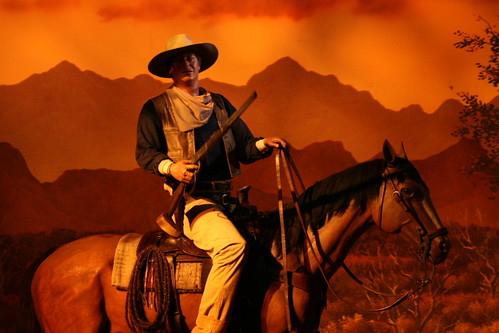
I believe in the American Spirit that John Wayne epitomizes in the movie, Hondo. The picture at the beginning is John Wayne as Hondo Lane riding his horse.


WaPo staff writer Stephen Hunter wrote the following in a review of Hondo
He was tall and strong, encased in buckskin, his wise eyes hooded by the broad brim of his hat, looking to and possibly beyond the horizon. He was fair and calm. He was tough but not mean. He had temper but not rage, only decency under the muscle. He had a poetic streak and an emotional one; he knew what love was, just as he knew the drop of a .38- 40 from a Winchester carbine at 100 yards and how to knife-fight and fish and swim. He could ride or shoot or fight as well as any man alive, but he didn't seem to brag on it. He killed Indians but he loved Indians; he killed white men but they were low-down skunks. He protected. He made things safe and let you grow. Otherwise he believed in letting alone, doing his duty and setting an example. He didn't order you to be like him, he made you want to be like him.


Perhaps the next time you really start to feel depressed with the news you ought to watch Hondo. It's a great movie, and a great reminder of rugged American individualism that may not be in display so much yet I believe it still is present in the United States of America.

Sunday, March 01, 2009

Alexis de Tocqueville Describes Barack Obama's America


In Democracy in America, published in 1835, Tocqueville wrote of his travels through America in the early 19th Century when the market revolution, Western expansion, and Jacksonian democracy were radically transforming the fabric of American life. He saw democracy as an equation that balanced liberty and equality, concern for the individual as well as the community.


America, in contrast to the aristocratic ethic, was a society where hard work and money-making was the dominant ethic, where the common man enjoyed a level of dignity which was unprecedented, where commoners never deferred to elites, and where what he described as crass individualism and market capitalism had taken root to an extraordinary degree.


The uniquely American morals and opinions, Tocqueville argued, lay in the origins of American society and derived from the peculiar social conditions that had welcomed colonists in prior centuries. Unlike Europe, venturers to America found a vast expanse of open land. Any and all who arrived could own their own land and cultivate an independent life. Sparse elites and a number of landed aristocrats existed, but, according to Tocqueville, these few stood no chance against the rapidly developing values bred by such vast land ownership. With such an open society, layered with so much opportunity, men of all sorts began working their way up in the world: industriousness became a dominant ethic, and "middling" values began taking root.


This equality of social conditions bred political and civilian values which determined the type of legislation passed in the colonies and later the states. By the late 18th Century, democratic values which championed money-making, hard work, and individualism had eradicated, in the North, most remaining vestiges of old world aristocracy and values. Eliminating them in the South proved more difficult, for slavery had produced a landed aristocracy and web of patronage and dependence similar to the old world, which would last until the antebellum period before the Civil War.


In Europe, he claimed, nobody cared about making money. The lower classes had no hope of gaining more than minimal wealth, while the upper classes found it crass, vulgar, and unbecoming of their sort to care about something as unseemly as money; many were virtually guaranteed wealth and took it for granted. At the same time in America workers would see people fashioned in exquisite attire and merely proclaim that through hard work they too would soon possess the fortune necessary to enjoy such luxuries.


At The Weekly Standard website is an excellent translation of part of his writing being a timeless critique from Toqueville of Barack Obama's America.


From Democracy in America, volume two, part four, chapter six: What Kind of Despotism Democratic Nations Have to Fear (translated by Harvey C. Mansfield and Delba Winthrop)


I encourage you to read it in its entirety. Here is an excerpt that particularly caught my eye.


It seems that if despotism came to be established in the democratic nations of our day, it would have other characteristics: it would be more extensive and milder, and it would degrade men without tormenting them ...


I do not fear that in their chiefs they will find tyrants, but rather schoolmasters...


It would resemble paternal power if, like that, it had for its object to prepare men for manhood; but on the contrary, it seeks only to keep them fixed irrevocably in childhood; it likes citizens to enjoy themselves provided that they think only of enjoying themselves. It willingly works for their happiness; but it wants to be the unique agent and sole arbiter of that; it provides for their security, foresees and secures their needs, facilitates their pleasures, conducts their principal affairs, directs their industry, regulates their estates, divides their inheritances; can it not take away from them entirely the trouble of thinking and the pain of living?


The sovereign extends its arms over society as a whole; it covers its surface with a network of small, complicated, painstaking, uniform rules through which the

most original minds and the most vigorous souls cannot clear a way to surpass the crowd; it does not break wills but it softens them, bends them, and directs them; it rarely forces one to act, but it constantly opposes itself to one's acting; it does not destroy, it prevents things from being born; it does not tyrannize, it hinders, compromises, enervates, extinguishes, dazes, and finally reduces each nation to being nothing more than a herd of timid and industrious animals of which government is the shepherd ...

--Alexis de Tocqueville


Alexis de Tocqueville imagines a scenario of how despotism could come to the USA. His scenario does not describe an external force coming into the country with gun ablazing to to overwhelm our citizenry by military force. What it does describe is despotism coming from within by politicians who promise to facilitate your pleasures, and manage and control your unpleasant principal affairs so you won't have to think, and in return just let the government be your shepherd. This philosophy needs to be pointed out to everyone who will listen. Just like Rush said yesterday the philosphy is much more important than the policy and process work with respect the network of small, complicated, painstaking, uniform rules that the Obama administration are unleashing upon us. Don't just whittle around the edges on this stuff. Oppose the entire philosophy of authoritarian despots.

Saturday, February 28, 2009

Fisking Marx


Fisking Marx


No, I am not referring to Karl Marx who wrote Das Kapital in 1867. I am referring to Reinhard Marx who wrote Das Kapital in 2008. Archbishop Marx's book carries the subtitle, A plea for the people


Reinhard Marx is now archbishop of Munich and Freising. Until January 2008, he was bishop of Trier, the birthplace in 1818 of Karl Marx.

Roman Catholic Archbishop Reinhard Marx


Was Marx's critique of capitalism right after all? It lasted longer than you expected back in the 19th century, but could it be that capitalism is just an episode of history that will end at some point because the system will collapse as a result of its internal contradictions? At the end of the 20th century, when the capitalist West defeated the communist East in the battle between systems, were we too quick to dismiss Karl Marx and his economic theories?


Capitalism without an ethic and a legal framework is inhumane. This was my conclusion from the finance and banking crisis. I already believed years ago that wild speculation is a sin. I have been an outspoken critic of the culture of greed in modern capitalism and have repeatedly pleaded with managers to subscribe to the social components of a social market economy. I criticise the audacious salary hikes of top managers. Neither primitive capitalism nor a return to Marxism will help create global justice. We need a structured market economy, not a revolution. The central question of the 21st century will be how to solve global problems like social injustice and poverty.


What a pantload of bull crap! To answer your questions, Reinhard, No! Marx's critique of capitalism was not right after all. No! the capitalist system will not collapse as a result of its internal contradictions. No! we were not too quick to dismiss Karl Marx and his economic theories. We may have been too quick to not hold when the USSR collapsed the same kind of tribunals held after Hitler and the Third Reich were defeated.


I reject your narrative that an inhumane unbridled capitalism has flourished, and that capitalism promotes a culture of greed. I believe that there will always be poor people, there will always be injustice, and there will always be sinners.


Never did John Locke, David Hume, Adam Smith, John Stuart Mill, Ayn Rand, F.A. Hayek, or Milton Friedman advocate unbridled capitalism or freedom. It seems that socialists have badly sullied the reputation of liberty. The socialists have repeatedly alleged that capitalism caters to so-called capitalists and gives them unbridled powers to exploit the weak. But that is totally false. Philosophers of liberty have always insisted that freedom comes with responsibility and justice. Adam Smith opposed mercantilism and monopolistic industrial interests. David Ricardo wanted more competition and free trade. Adam Smith and John Stuart Mill advocated labor unions to face the economic power of the owners of industry.


By repeating lies against liberty long enough, socialists have made it appear that the system of natural liberty encourages corruption and things like the sub-prime crisis. But what are the actual facts? Capitalism begins by looking at human nature. Hobbes and Locke, pointed out that since human nature is far from perfect, some people will always try to cheat, mislead, and misuse their powers. So if anyone cheats, then systems of justice should catch and punish the cheats. Thus everyone must be held equally to account and no one is to be above the law. In this manner, by ensuring all crimes are punished, capitalist societies are today among the most ethical on this planet.


Capitalism is also a system of continuous improvement. Lessons from events like the sub-prime crisis are quickly learned and such events prevented from happening again. Some events are complex and finding their causes can take time; but overall, capitalism is a political and economic system founded on democratic choice, law and order, and continuous improvement. And since the governance of capitalist societies is built on the system of checks and balances advocated by Montesquieu and Thomas Jefferson, the concept of capitalism being unbridled simply does not arise!


Our quarrel must be with socialism. In socialist societies, based as the spurious concept of economic equality, state-sanctioned corruption is the norm.


So who is really unbridled? Who is really immoral? Is it socialist countries ? where the governments are totally corrupt, where industrialists are gifted monopoly powers by the corrupt state, and where lives of workers are treated with disdain ? or is it the capitalist West where governments wage a systematic battle against all forms of corruption and irresponsible behaviour? Clearly, it is not capitalism but socialism we must be afraid of.


Unlike Karl Marx, who was a revolutionary, Adam Smith was a reformer. Where Karl Marx saw class struggle, Adam Smith saw special interests that were often at odds with the public interest. If Adam Smith were alive today, it is unlikely that he would join the chorus of triumphant anticommunists. Instead, he would warn that capitalism is prone to excess. He would observe that vigilance is required to ensure that the political system is not manipulated for the economic benefit of a few to the detriment of the entire society. He would be advocating political reforms to make sure that the system is not corrupted by special interests.


Adam Smith described free markets as an obvious and simple system of natural liberty. He did not favor the landowner, the factory owner, or the worker, but rather all of society. He saw, however, self-defeating forces at work, preventing the full operation of the free market and undermining the wealth of all nations.


The political foundation of Marx's utopia always had a critical structural flaw. He never explained how the members of the transitional dictatorship would be chosen, and why they would voluntarily relinquish their authoritarian power.


That critical structural flaw in the quest you have, Reinhard, to solve global problems like social injustice and poverty is the one you better think long and hard about.

Tuesday, February 17, 2009

The Obama Administration Is Not Clueless

There are so many pundits and journalists who are willing to carry the water for the Obama Administration. They report to their viewers, listeners, and readers that nobody knows for sure what effect the Obama Stimulus Plan is going to have, and if there is a further downturn that it would just be an unintended consequence of this youthful inexperienced team. I do not buy this narrative. Not one bit of it. This team is composed of the far left fringe of the Democratic Party. The end results they want, and the means they use to get them are not new at all. Karl Marx spoke at length about this in March of 1850 to an audience of members the Communist League in London.


Karl Marx described the political parties in Germany, what is the desired end result, what is not possible to do directly, and what is possible to do.


Since the defeat of the German and French revolutionary parties in July 1849, almost all the members of the Central Committee have reassembled in London: they have replenished their numbers with new revolutionary forces and set about reorganizing the League with renewed zeal.


This reorganization can only be achieved by an emissary, and the Central Committee considers it most important to dispatch the emissary at this very moment, when a new revolution is imminent, that is, when the workers' party must go into battle with the maximum degree of organization, unity and independence, so that it is not exploited and taken in tow by the bourgeoisie as in 1848.


This democratic party, which is far more dangerous for the workers than were the liberals earlier, is composed of three elements: 1) The most progressive elements of the big bourgeoisie, who pursue the goal of the immediate and complete overthrow of feudalism and absolutism. 2) The constitutional-democratic petty bourgeois, whose main aim during the previous movement was the formation of a more or less democratic federal state; 3) The republican petty bourgeois, whose ideal is to abolish the pressure exerted by big capital on small capital, by the big bourgeoisie on the petty bourgeoisie. The representatives of this faction were the members of the democratic congresses and committees, the leaders of the democratic associations and the editors of the democratic newspapers.


The relationship of the revolutionary workers' party to the petty-bourgeois democrats is this: it cooperates with them against the party which they aim to overthrow; it opposes them wherever they wish to secure their own position.


As far as the workers are concerned one thing, above all, is definite: they are to remain wage labourers as before. However, the democratic petty bourgeois want better wages and security for the workers, and hope to achieve this by an extension of state employment and by welfare measures; in short, they hope to bribe the workers with a more or less disguised form of alms and to break their revolutionary strength by temporarily rendering their situation tolerable. But these demands can in no way satisfy the party of the proletariat. While the democratic petty bourgeois want to bring the revolution to an end as quickly as possible, achieving at most the aims already mentioned, it is our interest and our task to make the revolution permanent until all the more or less propertied classes have been driven from their ruling positions, until the proletariat has conquered state power and until the association of the proletarians has progressed sufficiently far - not only in one country but in all the leading countries of the world - that competition between the proletarians of these countries ceases and at least the decisive forces of production are concentrated in the hands of the workers. Our concern cannot simply be to modify private property, but to abolish it, not to hush up class antagonisms but to abolish classes, not to improve the existing society but to found a new one.


We have seen how the next upsurge will bring the democrats to power and how they will be forced to propose more or less socialistic measures. it will be asked what measures the workers are to propose in reply. At the beginning, of course, the workers cannot propose any directly communist measures. But the following courses of action are possible:


1. They can force the democrats to make inroads into as many areas of the existing social order as possible, so as to disturb its regular functioning and so that the petty-bourgeois democrats compromise themselves; furthermore, the workers can force the concentration of as many productive forces as possible - means of transport, factories, railways, etc. - in the hands of the state.


2. They must drive the proposals of the democrats to their logical extreme (the democrats will in any case act in a reformist and not a revolutionary manner) and transform these proposals into direct attacks on private property. If, for instance, the petty bourgeoisie propose the purchase of the railways and factories, the workers must demand that these railways and factories simply be confiscated by the state without compensation as the property of reactionaries. If the democrats propose a proportional tax, then the workers must demand a progressive tax; if the democrats themselves propose a moderate progressive tax, then the workers must insist on a tax whose rates rise so steeply that big capital is ruined by it; if the democrats demand the regulation of the state debt, then the workers must demand national bankruptcy.


The way I see it, the Congress leadership and White House are akin to the revolutionary workers' party. The editors of democratic newspapers, CEOs of green economy small businesses, and rank and file members of the Democratic Party are akin to the petty-bourgeois democrats. They have been useful idiots to help overthrow the GOP, but they will be turned on wherever they wish to secure their position of power.


That speech that Karl Marx gave in London about 159 years ago in London is very similar to speeches today in Washington, DC.

Sunday, February 15, 2009

The Needy Get Something - The Greedy Get Nothing


http://karbuuno.com/wp-content/uploads/2008/11/barack-obama1.jpg61km1


The Needy Get Something - The Greedy Get Nothing


This is basically the slogan of the Obama Stimulus Plan, and this is why no House Republicans voted for this bill. This is basically a choice between the philosophy of Karl Marx, and the philosophy of Adam Smith. Let's look at some points Karl Marx made, and translate them into points made by Obama.


Karl Marx address of the Central Committee to the Communist League

We have seen how the next upsurge will bring the democrats to power and how they will be forced to propose more or less socialistic measures. it will be asked what measures the workers are to propose in reply. At the beginning, of course, the workers cannot propose any directly communist measures. But the following courses of action are possible:


1. They can force the democrats to make inroads into as many areas of the existing social order as possible, so as to disturb its regular functioning and so that the petty-bourgeois democrats compromise themselves; furthermore, the workers can force the concentration of as many productive forces as possible - means of transport, factories, railways, etc. - in the hands of the state.


2. They must drive the proposals of the democrats to their logical extreme (the democrats will in any case act in a reformist and not a revolutionary manner) and transform these proposals into direct attacks on private property. If, for instance, the petty bourgeoisie propose the purchase of the railways and factories, the workers must demand that these railways and factories simply be confiscated by the state without compensation as the property of reactionaries. If the democrats propose a proportional tax, then the workers must demand a progressive tax; if the democrats themselves propose a moderate progressive tax, then the workers must insist on a tax whose rates rise so steeply that big capital is ruined by it; if the democrats demand the regulation of the state debt, then the workers must demand national bankruptcy. The demands of the workers will thus have to be adjusted according to the measures and concessions of the democrats.


Although the German workers cannot come to power and achieve the realization of their class interests without passing through a protracted revolutionary development, this time they can at least be certain that the first act of the approaching revolutionary drama will coincide with the direct victory of their own class in France and will thereby be accelerated. But they themselves must contribute most to their final victory, by informing themselves of their own class interests, by taking up their independent political position as soon as possible, by not allowing themselves to be misled by the hypocritical phrases of the democratic petty bourgeoisie into doubting for one minute the necessity of an independently organized party of the proletariat. Their battle-cry must be: The Permanent Revolution.


Barack Obama's economic speech in Indianapolis

It's time to turn the page on eight years of economic policies that put Wall Street before Main Street but ended up hurting both. We need policies that grow our economy from the bottom-up, so that every American, everywhere, has the chance to get ahead. Not just the person who owns the factory, but the men and women who work on its floor.


Well, the working families who've been hard hit by this economic crisis - folks who can't pay their mortgages or their medical bills or send their kids to college - they can't afford to go to the back of the line behind CEOs and Wall Street banks. They need help right here, right now - and that's why I'm running for President of the United States.


Few have been harder hit by our credit crisis than the workers who make our cars and the companies that supply their parts. Now, when it came to rescuing Wall Street, Washington didn't waste a minute. But now that auto-workers are suffering, Washington's put on the brakes.


For the last eight years, we've given more and more to those with the most and hoped that prosperity would trickle down to everyone else. And guess what? It didn't. So it's time to try something new. It's time to grow this economy from the bottom-up.


Now, make no mistake: the change we need won't come easy or without cost. We will all need to tighten our belts, we will all need to sacrifice and we will all need to pull our weight because now more than ever, we are all in this together.


For those readers from Rio Lindo, Karl Marx phrase "petty bourgeoisie" equals Barack Obama phrase "person who owns the factory." Karl Marx phrase "organized party of the proletariat" equals Barack Obama phrase "unionized men and women who work on the factory floor."


Adam Smith had some things to say about this topic. Let's look at some of the points Adam Smith made, and unfortunately there are no translations of his ideas in Barack Obama.


Adam Smith

To enhance the wealth of a nation, every man, consistent with the law, should be free to pursue his own interest his own way, and to bring both his industry and capital into competition with those of other men. It is not from the benevolence of the butcher, the brewer, or the baker, that we expect our dinner, but from their regard to their own interest. The individual is driven by private gain but is led by an invisible hand to promote the public good, which was no part of his intention.


The skill, dexterity, and judgment with which labor is generally applied is one of the essential determinants of a nation's standard of living. Whatever be the soil, climate, or extent of territory of any particular nation, the abundance or scantiness of its annual supply must in that particular situation, depend upon the productive powers of labor.


No society can surely be flourishing and happy, of which the far greater part of the members are poor and miserable. It is but equity, besides, that they who feed, clothe and lodge the whole body of the people, should have such a share of the produce of their own labor as to be themselves tolerably well fed, clothed and lodged. It is not very unreasonable that the rich should contribute to the public expense, not only in proportion to their revenue, but something more than in that proportion.


In every country it always is and must be the interest of the great body of the people to buy whatever they want of those who sell it cheapest. The proposition is so very manifest that it seems ridiculous to take any pains to prove it; nor could it ever have been called in question had not the interested sophistry of merchants and manufacturers confounded the common sense of mankind. Their interest is, in this respect, directly opposite to that of the great body of the people. As it is the interest of the freemen of a corporation to hinder the rest of the inhabitants from employing any workmen but themselves, so it is the interest of the merchants and manufacturers of every country to secure to themselves the monopoly of the home market.


Adam Smith promoted free trade, good conditions for workers, progressive taxation and competition to benefit the public. The men and women who work on the factory floor could well ensure their relevance in a globalised world by embracing Adam Smith rather than Karl Marx.


I could not care less about parts of the Obama Stimulus Plan where condoms are distributed and pamphlets encouraging people to stop smoking. But I do deeply care about the parts of the plan that declare a war on capping individual achievements and limit who we can buy from, and how much we have to pay for what we buy. Increasing the size, scope, power, and central planning for life's basic necessities by the Federal Government bothers me a lot.


Saturday, February 14, 2009

The USA Has Its Own Fidel - YIPPEE!


The USA Has Its Own Fidel - YIPPEE!


This past Tuesday night Tavis Smiley interviewed Carlos Moore on the Tavis Smiley Show on PBS. A transcript of this interview can be read here.


What I find especially disturbing and vile is this comment by Tavis:


There are a couple of things you said in this conversation, Dr. Moore, that I found - at least I heard as interesting parallels between your experience back in the day and the experience that many young African Americans, 17, like you were at one point, are having today - 17, 18, and beyond. And that is, one, this notion of feeling that now that we have a guy named Obama in the White House, we have President Obama now, there are many young people who are as ecstatic and as excited and as enthused about President Obama as you were about your new president, Fidel Castro.


Say what, Tavis? You hear this as interesting parallels? How about hearing this as disturbing parallels or horrific parallels? I would have expected the left to deny, debunk, and refute to the listening public any parallels between Fidel and Barack.


This is just another example of a sickness within the hearts and minds of many Americans that needs to be challenged, and there is no conservative cavalry riding in from our nation's capitol to save us. For too long too many heads are being filled with mush extolling the wondrous possibilities of a workers' paradise if we just follow the philosophy of Karl Marx.


We need to work at the local level with new educators, unions, community organizations, and journalists to inform people about the philosophy of Adam Smith. History needs to be taught revealing how misery and failure have borne out everywhere that Karl Marx's ideas have been tried, and prosperity have borne out everywhere that Adam Smith's ideas have been tried.


Since this is Valentine's Day, I do not want a write a diary that only talks about sickness. There is another event recently that provides an example of wellness. Charles Krauthammer writes about it here. The article is about good news from Iraq's elections that is not being widely reported. I encouraage everyone to read the entire article. These are some of the points from the article:


All the parties that had the words 'Islamic' or 'Arab' in their names lost, noted Middle East expert Amir Taheri. By contrast, all those that had the words 'Iraq' or 'Iraqi' gained.


Prime Minister Nouri al-Maliki went from leader of a small Islamic party to leader of the "State of the Law Party," campaigning on security and secular nationalism. He won a smashing victory. His chief rival, a more sectarian and pro-Iranian Shiite religious party, was devastated. Another major Islamic party, the pro-Iranian Sadr faction, went from 11 percent of the vote to 3 percent, losing badly in its stronghold of Baghdad. The Islamic Fadhila party that had dominated Basra was almost wiped out.


The once-dominant Sunni party affiliated with the Muslim Brotherhood and the erstwhile insurgency was badly set back. New grass-roots tribal ("Awakening") and secular Sunni leaders emerged.


But in the intervening years, while the critics washed their hands of Iraq, it began developing the sinews of civil society: a vibrant free press, a plethora of parties, the habits of negotiation and coalition-building. Reflecting these new realities, Grand Ayatollah Ali Sistani this time purposely and publicly backed no party, strongly signaling a return -- contra Iran -- to the Iraqi tradition of secular governance.


I think it will be a great idea for us Americans to renew our beliefs in free market capitalism and a vibrant free press. Where this is tried it is successful.

Saturday, February 07, 2009

Where Have All the Tough Guys Gone?


Graham Amdt. No. 501 As Modified


This amendment transfers the STD prevention and smoking cessation program money to an FDIC mortgage foreclosure prevention program.


rejected by a vote of 57-39


the 57 nay votes included 3 Rs


Sen. Bunning

Sen. Collins

Sen. Snowe


the 39 yea votes included 3 Ds


Sen. Conrad

Sen. Dorgan

Sen. Feingold


Sen. Baucus says passage of the amendment would affect some chunk of money that would complicate the later passage of the compromise package.


pilgrim's translation-The US taxpayers are getting screwed, and so they need the condoms. They need to stop smoking because after the screwing they are getting they can't afford a cigarette afterward.


Vitter Amdt. No. 107


Prohibiting direct or indirect use of funds to fund the Association of Community Organizations for Reform Now (ACORN).


rejected by a vote of 51-45

all 51 nay votes were Ds


the "bipartisan" yea votes included

Sen. Baucus

Sen. Bayh

Sen. Byrd

Sen. Hagan

Sen. Nelson of Nebraska

Sen. Tester


Sen. Durban says that passage of the amendment will be a slap in the face to some true American patriots in ACORN. They did community organizing work in Louisiana in the aftermath of hurricane Katrina, and this is the thanks they get.


pilgrim's translation-ACORN plays a major role in getting Ds elected so defeat this amendment and give our guys their political payback.


This bill is vile to the core, and whittling around the edges with these amendments by Vitter and Graham is a silly kabuki dance that diverts from the main point. The main point is that this bill grows the size and scope of the government like we have not seen since FDR. FDR did not have a historical record to show the fallacies in his approach, and still Obama and the Ds do have a historical record that they don't care about.


Dan Kennedy has an excellent column over at TownHall with the title Where Have All the Tough Guys Gone?


In an interview in the January issue of Esquire, super tough guy and Cleveland Brown of all Cleveland Browns, Jim Brown said:

A liberal is arrogant enough to think he can do you a half-***ed favor. He is superior enough to think he can give you something that you don't deserve. A liberal will cut off your leg so he can hand you a crutch.


Jim Brown never missed a game in his nine record-breaking seasons with the Browns. He also rarely stepped out of bounds to avoid a high speed hit or bruising tackle. Instead he lowered a shoulder and knocked everyone else on their ***es. In the interview he says that the biggest crutch is thinking you're a victim. I imagine if a liberal handed Jim a crutch, he'd beat him over the head with it. Even if he had to hop on one good leg while doing it.